Programming Life at Scale

Most investors tracking the reshoring trend are looking at the same three places: semiconductors, batteries, and critical minerals. That focus is understandable — those sectors dominate the headlines and attract the largest subsidies.
But there’s a quieter industrial shift underway that gets a fraction of the attention. It’s slower, more technical, and far less photogenic. And over the next 10 to 15 years, it could change how a whole category of materials, ingredients, and even pharmaceutical components is actually made.
I’m talking about synthetic biology finally crossing the line from laboratory experiment to industrial-scale manufacturing.
Here’s the part that makes it interesting for investors: this is a field where billions have been raised and incinerated, and yet — at the very same time — engineered microbes are already making the enzymes in your laundry detergent, the protein supplements in animal feed, and a meaningful share of newly approved drugs. Spectacular public failures sitting right next to quiet, invisible adoption. When a sector looks like that, the market usually hasn’t figured out how to price it. That’s typically where the more interesting long-term opportunities hide.
For years, synthetic biology was associated with high-profile, small-scale wins. Companies could engineer a microbe to produce a specific molecule in the lab. Turning that into reliable, cost-effective production at industrial volume proved brutally hard. Most promising projects simply stalled at the demonstration stage.
Then the flagships fell — fast and hard. Amyris, once a multi-billion-dollar name, filed for Chapter 11 in 2023 carrying more than a billion dollars in debt. Zymergen, which was betting on microbes to make flexible plastic films, was effectively wound down. Ginkgo Bioworks, the “operating system for biology,” saw its stock collapse roughly 98% from its peak and laid off a large share of its workforce.
It would be easy to read that as “the technology doesn’t work.” That’s the wrong lesson, and getting the lesson right is the whole game.
Look closely at Amyris and the failure wasn’t really biological. The company built a pipeline of more than a dozen products and couldn’t make any single one of them profitable enough to carry its cost base. As one of its own co-founders put it afterward, the problem was an abundance of ideas and money, and a lack of focus. Early-stage starvation, he argued, would actually have forced better decisions. In other words: this was a discipline and unit-economics failure dressed up as a scaling failure.
That distinction is exactly what separates the companies now quietly working from the ones that became cautionary tales.
Why this shift matters now
What makes the current moment different is where it sits at the intersection of two powerful, durable trends.
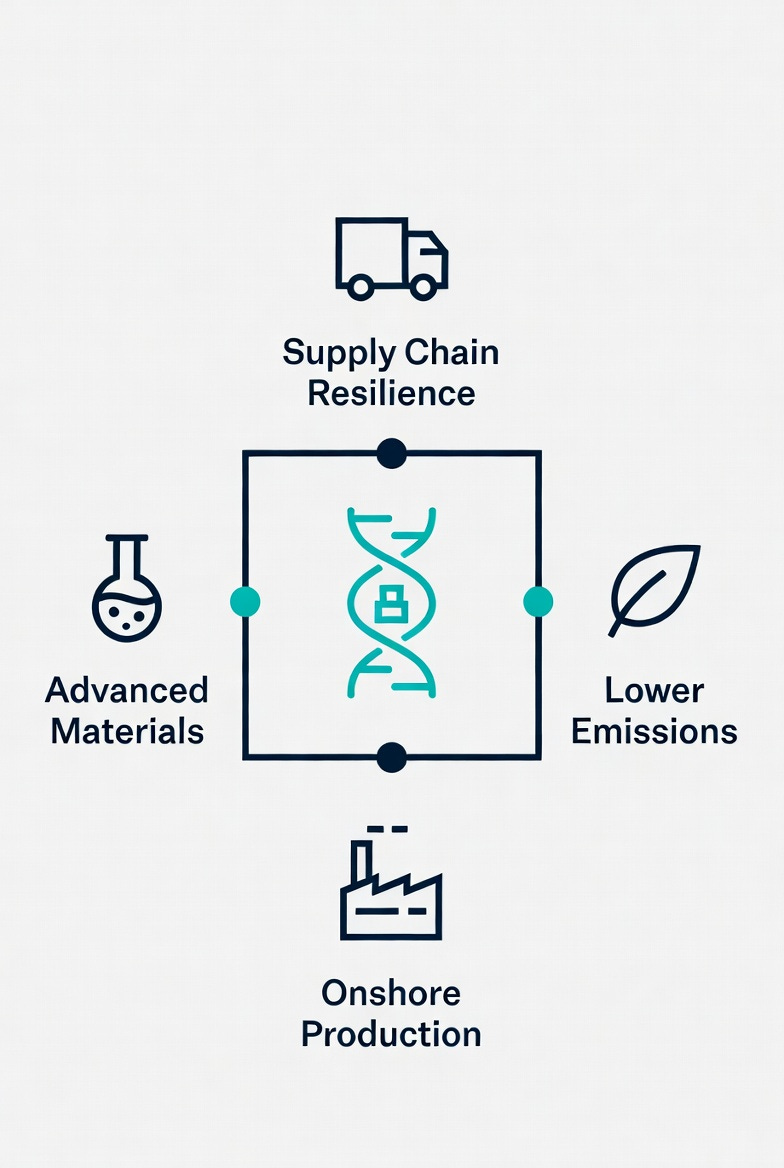
On one side, companies and governments are scrambling to shorten and secure supply chains. On the other, there’s mounting structural pressure to decarbonize chemical and material production — and I mean structural, not aspirational. The volume of corporate value-chain emissions commitments (Scope 3) has grown at a double-digit annual rate, putting a vast pool of chemical and materials spending formally “under scrutiny.” That converts decarbonization from a moral talking point into something far more investable: a captive, contractually-driven source of demand for lower-carbon production routes.
Synthetic biology speaks to both pressures at once. Instead of extracting a compound from a plant or synthesizing it through an energy-hungry chemical process, you can use an engineered microorganism as the production platform — sometimes closer to the point of demand, often with a lower carbon footprint.
But notice how the central question has quietly changed. In 2021, the question was does the biology work? In 2026, the biology mostly works. The question now is sharper and far more financial: at what fermentation yield per liter does the unit economics actually flip — and which companies can hold that economics steady at industrial volume, batch after batch?
That is a completely different question, and it’s the one that separates winners from value traps.
Where things actually stand in 2026
The picture is genuinely uneven, and honesty about that is part of the opportunity.
On the hard side: scaling remains where dreams go to die. Going from a clean lab process to a stable, profitable industrial facility is a different discipline entirely, and several well-funded names have learned that the expensive way.
On the encouraging side, the signals of maturity are piling up:
Titers are crossing economic thresholds. Yield (titer — grams of product per liter of broth) is the single biggest driver of fermentation economics, because higher titers cut downstream processing and capital intensity. Reaching ~100 g/L for complex molecules used to be rare; some players are now reporting exactly that, and claiming cost parity with the incumbent products they aim to replace.
Offtake is becoming bankable. The pattern of 2026 is unmistakable: long-term, fixed-volume supply agreements are replacing vague exploratory partnerships. Multi-year deals, sometimes anchored by large strategic corporates and even sovereign-backed funds, are showing up before facilities are built. That matters enormously, because a credible offtake from a creditworthy buyer is what makes a capital-intensive plant financeable in the first place.
Discipline is back in fashion. The survivors are doing the opposite of Amyris: narrowing to the handful of molecules where biology already has a clear edge, rather than spraying capital across a dozen moonshots.
None of this means biology is about to replace chemical manufacturing across the board. For most molecules, the economics still don’t work. But the trajectory is becoming legible: synthetic biology is graduating from a research tool into a genuine piece of industrial manufacturing infrastructure — and as one industry observer put it, its real achievement in 2026 may be that it’s finally becoming boring. Boring, in this business, is what success looks like.
What this free edition gives you — and what comes next
This section is the lay of the land: the broad context, the wreckage and what it really teaches, and the state of play in 2026.
In the Macro Notes Premium edition, I go where it actually matters for a portfolio:
The three-part filter I use to separate survivors from value traps — product focus, unit economics (and the specific titer thresholds that flip the math), and offtake bankability — applied company by company.
The distinct technical and business models competing right now, and my read on which look viable at scaleversus which are running the Amyris playbook again.
The specific names that have already converted letters of intent into signed, sold-out commercial supply — and the ones I’d avoid despite the hype.
The real operational and economic traps still standing between a pilot plant and a profitable facility.
The 2–3 developments over the next 18–24 months I’m watching most closely, because they’ll likely decide which way this theme breaks for investors.
If you want a concrete read on how synthetic biology is moving from promising science to actual industrial capability — and which companies are positioned to capture it — that’s where the full analysis lives…
Become a premium subscriber to unlock all of our editions. What we offer is in-depth research covering more than 100 investment theses that we actively track, deep dives into the best opportunities we identify, and complete transparency and openness about our positions and portfolio…
Macro Notes Premium - Synthetic Biology Goes Industrial