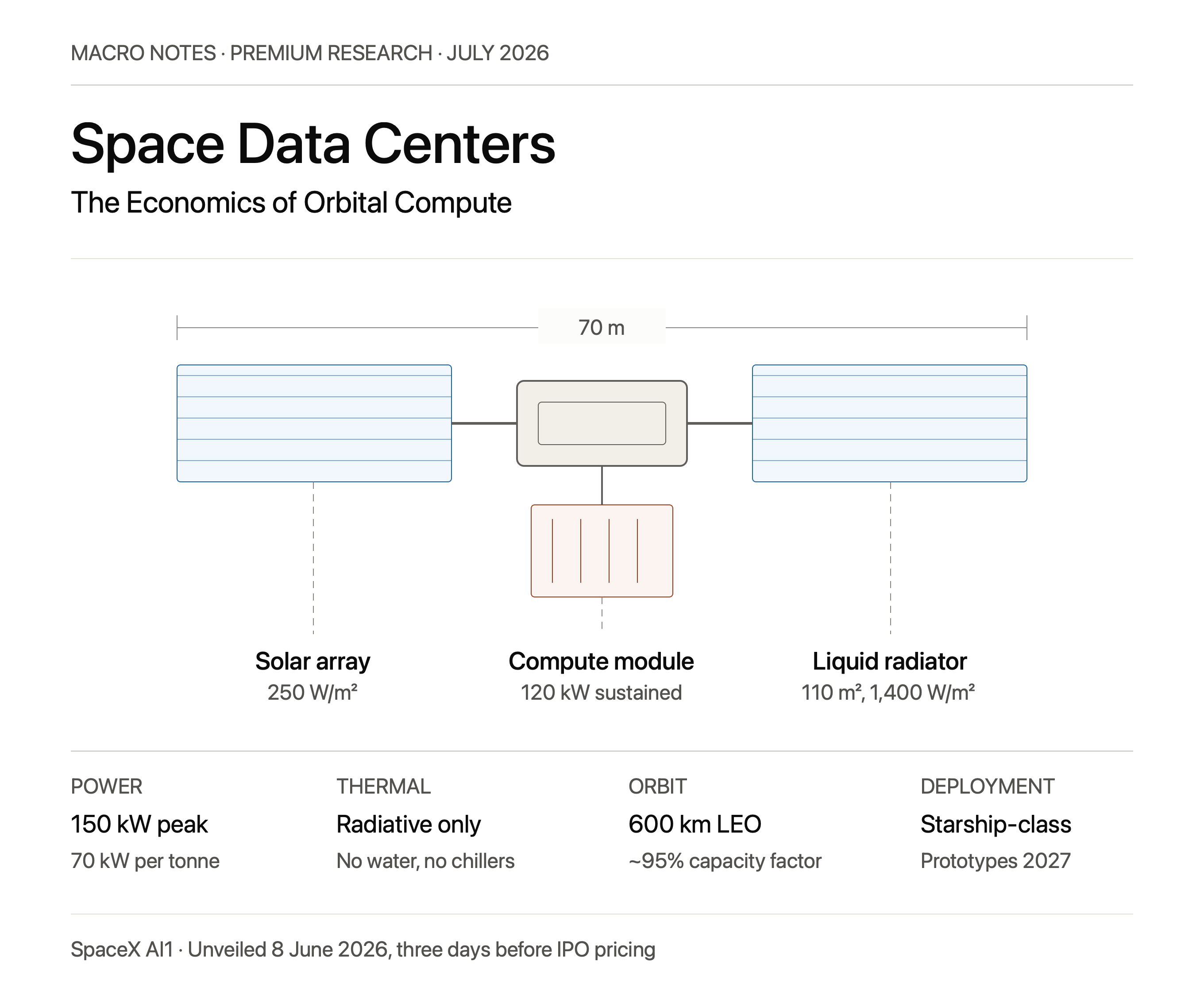
Space Data Centers - The Economics of Orbital Compute


This edition comes right after the SpaceX IPO — because I’m convinced the real winners of SpaceX will be long-term investors, just as they were with Tesla. Musk makes very long-dated bets. These are stocks you hold. Apple was the same story: you’re not betting on next quarter’s earnings, you’re betting on a societal revolution, on the future the company intends to build.
In short: I’ll buy SpaceX when it hits its lows. And in this edition, I want to go deep on space data centers — because the subject is poorly understood, poorly explained, and very few people grasp its real limits and its real potential.
Elon Musk is a salesman. He sells data centers the way they need to be sold — simplified, accessible, exciting. He unveiled the AI1 satellite on June 8. The IPO priced on June 11. Three days. That is not a coincidence, and we’ll come back to it.
But as an investor, you may want to go further. Deeper.
If you’re not a Premium subscriber yet: this edition alone is worth the price of a full year of Macro Notes. Join hundreds of premium readers and get access to our community of investors who read our macro research and invest alongside us.
If you read Macro Notes, you belong to a certain category of investor — the kind who wants to understand what they own. Not just the financial anatomy of an asset, but where the value actually sits.
So here’s the plan.
You’ll find that space data centers go far beyond the question of access to orbit.
We’ll start with demand — the real thing, not the narrative. Where compute demand actually comes from, how it’s evolving, and why the terrestrial power grid — not the chip — is now the binding constraint. Roughly 2,300 GW is sitting in U.S. interconnection queues: more than the entire installed generating capacity of the country. Median wait, over five years. Historical completion rate, 13%. This is why CoreWeave paid $9 billion for Core Scientific and wasn’t buying hardware — it was buying 1.3 gigawatts of existing grid connection. Out of this comes the single strongest argument for orbital compute, and it has nothing to do with cost. We put a number on it. Space isn’t cheap. Space is available. Almost nobody states that plainly, and it reorganizes the entire case.
Then feasibility — honestly, in both directions. The energy argument, where Musk is simply right and the skeptics are lazy. The thermal argument, where the most-cited bearish model on the internet is structurally wrong — and where AI1’s real architecture beats the theoretical model by design, for a reason we’ll walk through in full. And the radiation argument, where a 5–10x cost premium was quietly eliminated inside ninety days by Google and NVIDIA, moving the parity date by years. It was reported. It was not understood.
Then the bandwidth wall — and the workload split nobody makes. The downlink objection is correct for training and largely wrong for inference. That single distinction reorganizes the investment case, and it explains something the market has completely missed about SpaceX’s two headline AI compute contracts — worth over $2.1 billion a month combined. We’ll show you the filing. The revenue is not where you’ve been told it is.
Then risk and insurance — because $51 billion of uninsurable assets is not a technical footnote, it’s a cost-of-capital problem that nobody has connected to SpaceX’s valuation. Of roughly 13,000 active satellites, about 300 carry insurance, and most collision losses are excluded from the policies that do exist. AI1 will fly at 600 km — inside the exact altitude band that Kessler and Lewis concluded, in 2025, is already unstable. The OECD models a Kessler event at $191 billion of immediate losses. There’s a real paradox buried in this program: its success raises the probability of the event that ends it. And then the asymmetry no bull has answered — AI chips turn over every 12–18 months, while these satellites are built for a five-year life and cannot be serviced. On Earth, you forklift new chips through the same building. In orbit, you throw the building away with the chips inside it. We quantify what that does to returns on capital.
Then the economics. Three competing models, placed side by side for what I believe is the first time. Varda says orbital compute costs 3.2x its terrestrial equivalent. SemiAnalysis, in June, said $8.64 versus $2.37 per GPU-hour and put parity around 2040. Google says the mid-2030s. Starcloud says 2028. Musk implies now. These cannot all be true, and the spread between them is the entire investable question. We take each model apart, expose the assumption it’s leaning on, and identify which one breaks first.
Then the value chain — who actually gets paid. This is the section I expect you’ll use most. Morgan Stanley has now mapped 43 companies across the orbital compute supply chain — U.S., Taiwanese, Korean, European. We go through the layers: triple-junction solar cells, deployable radiators and active thermal loops, radiation-tolerant logic and memory, optical inter-satellite terminals, power conversion, structures. For each one, the only three questions that matter: is it constrained, is it commoditized, and is it already in the price? The answers are not where consensus thinks they are. One layer in particular has no qualified supplier at all today. That’s not a footnote. That’s a bottleneck — and bottlenecks are where returns live.
And finally, the verdict. A scenario tree with probabilities I’m willing to put my name to. A dated catalyst calendar running through 2030 — including the one disclosure that would change everything, and what to do the day it lands. And an answer to the only question that matters: not whether to own this, but at what price, and what has to be true.
And our research has led us to one conclusion that reframes the entire debate:
The market has fixated on launch cost per kilogram. That battle is already won — and it doesn’t matter as much as you’ve been told. Run the most rigorous model that exists on this subject and you find something genuinely counterintuitive: launch cost alone does not close the gap. You can drive the price of getting to orbit all the way down to Musk’s most aggressive published assumption, and orbital compute is still meaningfully more expensive than a data center on the ground.
There is a second variable. It decides whether orbital compute becomes a trillion-dollar industry or an expensive distraction. SpaceX has never disclosed it. It does not appear in the S-1. Not one analyst I can find is tracking it.And when you move it — alone, without any further help from Starship — the numbers cross. Orbit becomes cheaperthan Earth.
Elon Musk knows exactly which variable it is. He has never said so publicly. What he has done instead is quietly build an eleven-million-square-foot factory in Bastrop County, Texas, to solve it.
You do not build that to lower your launch costs. Starship already does that.
The factory is the tell. Below the line, we’ll show you what it’s telling you.
What This Research Delivers
A genuinely deep working knowledge of this market — the physics, the unit economics, the timelines, the competitive structure, and the specific assumptions each of them rests on. Enough to read every future headline on this subject and know instantly whether it matters.
But more than that: you’ll understand who captures the value in this new market, because it will not be one company.
SpaceX sits at the center of the value chain. It is the only player that controls launch, spacecraft, power, and — through Terafab — eventually the silicon itself. That vertical integration is the most important structural fact in the sector, and it’s the reason most of the pure-play startups you’ve been reading about cannot win. We show you exactly why, we name them, and we explain the specific dependency that traps them.
But the impact is far wider than SpaceX — and this is what the coverage keeps missing. An orbital data center is not a rocket. It’s a bill of materials. Every line of that bill is a supply chain, most of them held by companies that have nothing to do with rockets, several of them listed, and a few of them structurally constrained in ways the market has not yet priced.
We’ve studied that chain, measured it, and put numbers on it…