
The $2 Trillion Illusion

In 2007, at the Federal Reserve Bank of Kansas City’s annual symposium in Jackson Hole, a PIMCO economist named Paul McCulley coined a term for a phenomenon that had been growing in plain sight for two decades.
He called it “shadow banking” — the vast network of financial intermediaries that perform the same essential functions as banks (borrowing short, lending long, transforming credit risk) without any of the public infrastructure that makes banking stable: no deposit insurance, no discount window, no lender of last resort.
Two years earlier, at the same symposium, Raghuram Rajan — then chief economist of the IMF, later governor of the Reserve Bank of India — had identified the specific vulnerability McCulley would name.
The financial system, Rajan argued, had shifted risk from institutions that understood it to institutions that didn’t, through instruments that obscured it, funded by investors who hadn’t priced it. He was booed off the stage.
Larry Summers called his analysis “Luddite.” Eighteen months later, the global financial system collapsed along exactly the fault lines Rajan had described.
I bring this up because it’s happening again. Not in the same instruments. Not through the same channels.
But the same structural architecture — the same gap between what investors believe they own and what they actually own — has rebuilt itself in a different part of the financial system.
And the trigger that is exposing it is not interest rates, or a recession, or a housing collapse.
It is artificial intelligence…
Before we continue, here’s a message from our partner, Market Ontology. To sponsor Macro Notes and showcase your business to our audience, please contact sponsorships@altis.news
Sponsor
One terminal for macro, policy, and geopolitical risk
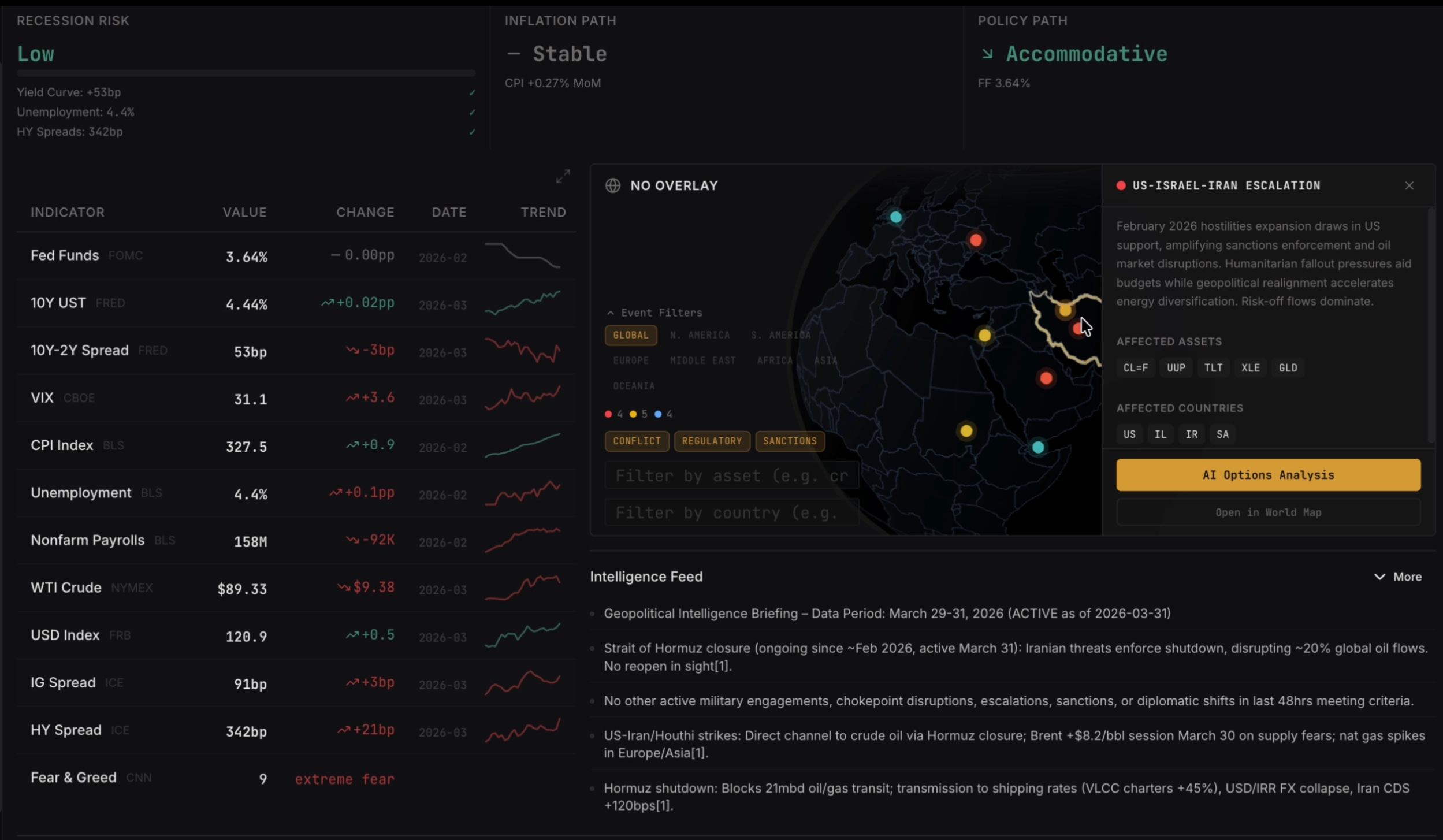
Market Ontology turns macro, policy, and geopolitical shocks into a unified market brief for investors.
Most tools show you what moved. The more important question is what matters next for rates, crude, spreads, volatility, and positioning. Usually you need to bounce between charts, headlines, terminals, notes, and policy trackers just to build a coherent view.
Market Ontology compresses that workflow into one operating module.
Investors can track live macro data, cross-asset stress, active geopolitical events, affected assets, and a live intelligence feed that translates noise into a usable market view. Instead of reading a policy headline in one place, checking oil in another, and then guessing what it means for spreads or volatility, you can see the transmission in context.
It is built for serious investors who want to understand what changed, why it matters, which assets are exposed, and what to monitor next.
Macro Notes readers can view the dedicated page and start a 14-day trial here:
The $2 Trillion Illusion – Continued
The asset class is called private credit. It’s the successor to the shadow banking system that imploded in 2008, rebuilt under new names, new structures, and a new regulatory framework that addressed the last crisis while creating the conditions for the next one.
Here is what happened after 2008 in the simplest possible terms. The Dodd-Frank Act and Basel III imposed higher capital requirements on banks. Banks responded rationally: they retreated from the riskiest lending — mid-market corporate loans, leveraged buyouts, venture-stage companies — because the regulatory cost of holding that risk on their balance sheets exceeded the return. A gap opened. And into that gap stepped a new category of lender: private credit funds, managed by firms like Apollo, Blackstone, KKR, Ares, and Blue Owl.
These funds raised capital from institutional investors (pension funds, endowments, sovereign wealth funds) and increasingly from retail investors through structures called Business Development Companies — publicly registered, SEC-supervised vehicles that pool capital to make direct loans to private companies. BDCs offered quarterly liquidity (subject to caps), 1099 tax reporting, and yields that exceeded anything available in public bond markets. The product was designed for the post-2008 world: higher returns without the volatility of equities, quarterly income without the lockups of traditional private equity.
The growth was exponential. Private credit AUM rose from roughly $400 billion in 2015 to over $2 trillion by the end of 2025. Goldman Sachs, Morgan Stanley, and JPMorgan projected it would reach $3 trillion by 2028. Blackstone, Apollo, and KKR each built private credit into their largest revenue segment. The Financial Stability Board tracked it. The IMF studied it. Jerome Powell testified about it. Everyone agreed it was important. Almost no one agreed on whether it was dangerous.
The Federal Reserve published a working paper in 2025 that documented the mechanism precisely: as bank credit to nonfinancial businesses slowed during the 2022 tightening cycle, lending to BDCs accelerated. BDCs maintained high utilization of bank credit lines while increasing their own loan origination. The system didn’t reduce leverage. It relocated it — from regulated balance sheets to semi-regulated ones. The risk didn’t disappear. It moved.
This is the structural point that matters: private credit did not solve the problem that caused 2008. It recreated the problem in a different container.
The original shadow banking system manufactured safe-seeming assets (AAA-rated mortgage-backed securities) from risky underlying loans (subprime mortgages) through credit tranching and maturity transformation. When the underlying risk was exposed, the “safe” assets turned out to be anything but. The system collapsed because what investors owned — AAA bonds — bore no relationship to what they actually held — concentrated bets on housing prices never declining.
Private credit performs the same alchemy in a different domain. It transforms illiquid corporate loans with three-to-seven-year maturities into products marketed as “semi-liquid” — quarterly redemptions, subject to a 5% cap. The underlying assets cannot be sold quickly. The wrapper promises they can be accessed quickly. The gap between the two is small when markets are calm. It becomes infinite when they’re not.
March 2026 demonstrated this with mathematical precision.
On March 23, Apollo Global Management disclosed that redemption requests for its flagship Apollo Debt Solutions BDC had reached 11.2% of outstanding shares — more than double the 5% quarterly cap the fund permits. Apollo honored $730 million of the $1.5 billion requested. Investors who sought to liquidate received 45 cents on each dollar they asked to withdraw. The remainder was deferred to future quarters, where the same cap applies.
Within days, Ares Management capped its own fund at 5% after requests hit 11.6%. Blackstone raised its cap from the standard 5% to 7.9% and injected $400 million of balance-sheet capital to meet the additional demand. Blue Owl Capital halted quarterly redemptions entirely, shifting to discretionary distributions at the board’s discretion. Across the sector, more than $10 billion in withdrawal requests accumulated in Q1 2026. The funds honored approximately 70%.
Goldman Sachs projected that the retail private credit sector could shed between $45 billion and $70 billion in assets over the next two years.
The stock prices of the firms that manage these funds collapsed. Apollo fell 30% year-to-date. Blackstone hit a two-year low. KKR dropped 44% from its 52-week high. Ares declined 48%. Blue Owl lost two-thirds of its value. In aggregate, more than $265 billion in market capitalization was erased from the alternative asset management sector.
Mohamed El-Erian, former co-CEO of PIMCO — the same firm where McCulley had named shadow banking nearly two decades earlier — compared the dynamics to the early stages of the 2008 crisis.
The question is why. What caused $10 billion in redemption requests to arrive simultaneously across multiple funds managed by different firms?
The proximate trigger was a deterioration in credit quality.
Fitch Ratings reported that the U.S. private credit default rate climbed to 5.8% by early 2026 — the highest since the index was created. High-profile bankruptcies in late 2025 — auto lender Tricolor, auto parts manufacturer First Brands — signaled that the stress was not confined to a single sector.
Jamie Dimon invoked the metaphor that would define the cycle: “When you see one cockroach, there are probably more.”
But the deeper cause — the structural one — is technological.
Between 2015 and 2025, private equity firms acquired more than 1,900 software companies in deals worth over $440 billion. The debt that financed those acquisitions constituted the single largest sector exposure in private credit.
By the end of 2025, software and technology loans represented approximately 25% of the entire private credit market, according to S&P data cited by PitchBook. UBS estimated the AI-disruption-exposed share at 25% to 35%.
The investment thesis behind this concentration was structurally sound — in the pre-AI economy. Software-as-a-service companies generate recurring revenue. Customers sign multi-year contracts. Switching costs are high.
Gross margins exceed 70%. Cash flows are predictable. For a lender, these characteristics represent the ideal borrower profile: steady income that services debt reliably across economic cycles.
Generative AI invalidated every one of these assumptions simultaneously.
Recurring revenue depends on customers renewing. When AI tools perform the same function at a fraction of the cost — when Anthropic ships an agent that replaces a $50,000/year SaaS contract with a $20/month subscription — renewal rates compress. Switching costs depend on integration complexity.
When AI reduces the cost of building replacement functionality from millions to thousands, the moat evaporates. Gross margins depend on low marginal cost of delivery. When the product itself becomes commoditized, margins converge toward zero.
The S&P North American Software Index fell 15% in January 2026 — its worst month since October 2008. Jefferies’ equity desk coined the term “SaaSpocalypse.” The public market repriced software stocks in days. The private market — where these companies’ loans sit, unmarked, on BDC balance sheets — has not yet repriced. This is the gap. This is the illusion.
When a software company that was acquired at 12x revenue in 2022 is trading at 6x in public comps, the $500 million in debt that was structured at 7x leverage no longer has an equity cushion.
The loan isn’t necessarily in default — the company may still be making interest payments from existing cash flows. But the margin of safety that justified the credit has disappeared. And the market knows it, even if the BDC’s quarterly NAV report doesn’t reflect it yet.
Morgan Stanley warned in a March 2026 research note that default rates in private credit could surge to 8%. UBS modeled an aggressive disruption scenario where they reach 13% — more than three times the projected rate for high-yield bonds. Apollo — arguably the most sophisticated credit underwriter in the industry — quietly cut its software exposure nearly in half during 2025, from approximately 20% to 10%.
When the smartest firm in the room is exiting a position that aggressively, it’s not a hedge. It’s an acknowledgment that the thesis has changed.
There is a second layer to this that connects private credit to the retirement system in ways that are not visible in any BDC filing.
Over the past decade, private equity firms have acquired or established insurance companies as vehicles for deploying private credit. Apollo’s Athene subsidiary manages over $300 billion in insurance assets. KKR’s Global Atlantic manages $170 billion. Blackstone manages hundreds of billions in insurance portfolios.
The model is straightforward: policyholder premiums — from annuities, life insurance, retirement products — are invested in private credit to generate the returns needed to pay future benefits.
The Chicago Fed estimated that life insurer investments in private credit reached $849 billion by 2024 — roughly half the sector’s total AUM. The Financial Times described insurance as the “lifeblood” of private credit.
Andrew Milgram, chief investment officer at Marblegate Asset Management, has publicly warned of a potential feedback loop: concern over private credit quality leads retirees to surrender their annuities, forcing insurers to liquidate private credit holdings, which depresses prices further, which amplifies concerns.
This is not a theoretical construct. It is the exact mechanism that transformed the 2007 subprime mortgage problem into the 2008 global financial crisis — when the question shifted from “are these assets impaired?” to “who else owns them?”
The firefighter in Ohio whose pension fund bought an annuity from an Apollo-affiliated insurer. The teacher in California whose retirement savings sit in a Blackstone-managed insurance portfolio.
They don’t know what a BDC is. They don’t know what private credit means. They don’t know that a quarter of the loans backing their retirement income were made to software companies whose competitive position is being structurally eroded by technology that didn’t exist when those loans were originated.
This is the illusion. Not a fraud. Not a conspiracy. An illusion — a systematic gap between what the financial system represents to its participants and what it actually contains.
The premium section continues with the structural analysis of where capital migrates when a $2 trillion asset class contracts — the three probability-weighted scenarios, the specific sectors absorbing the reallocation, the distressed debt opportunity framework, the connection to the r > g thesis on AI-driven capital productivity, and the positions I’m building in response.
🔒 Premium - What Happens When $2 Trillion Reprices
The intellectual framework I laid out in last week’s r > g was abstract by design — a structural argument about the divergence between capital returns and labor income, accelerated by AI. This week’s analysis is the first concrete application of that framework to a real-time market event….