
Why I Believe Humanoid Robots Are the Most Promising Investment Thesis of the Next Decade

Yesterday, I introduced the Optical Fibre investment thesis. If you missed that edition, I highly recommend reading it before continuing with this one.
The $73 Billion Fiber Optics Thesis

One of the best-performing investment theses we have developed this year has been Optical Fibre, generating a total return of more than 593% (as of 28 July).
It has been one of the best-performing investment theses I’ve shared to date.
But that doesn’t necessarily make it the most promising investment thesis I’ve shared in Macro Notes.
If you’re a Macro Notes Premium subscriber, you’ll also be able to follow the live portfolio behind this thesis inside Altis Terminal (some beta testers already have access).
Preview of the Humanoid Robots portfolio on Altis Terminal
As you can see, the portfolio has generated a total return of 91%.
For a thesis I’ve been covering since late 2024, that’s certainly a strong performance—but it’s not the reason I’m still excited about it.
In fact, I believe the opportunity has become even stronger throughout 2026, for three reasons.
The first is a technological breakthrough.
For the first time, AI models are becoming capable of controlling a physical body.
The second is the size of the market.
Most people assumed humanoid robots would eventually become a large industry. Today, that is no longer just speculation. Reliable research from institutions such as Citi, Goldman Sachs and Morgan Stanley suggests that even the most conservative estimates point to an extraordinarily large market.
The third reason is that we’re still early.
Mass adoption hasn’t started yet.
This reminds me of investing in Large Language Models just a few months before ChatGPT was released.
LLMs already existed.
Many of the capabilities that made ChatGPT revolutionary were already available through OpenAI’s Playground and research demos—but they were difficult to use and had almost no mainstream adoption.
If you experimented with those early models, you probably had the feeling that something important was about to happen.
That’s exactly how I feel about humanoid robots today.
But before going any further, it’s important to understand what this investment thesis actually is.
It isn’t simply that “robots will replace humans.” The real investment thesis is slightly different.
Artificial intelligence is automating intellectual work. Humanoid robots will automate physical work.
For decades, building a humanoid robot was primarily a hardware problem.
Batteries. Electric motors. Actuators. Sensors. Balance.
Today, most of those technologies already exist.
The real bottleneck was never the body. It was the brain.
How do you teach a robot to walk? Pick up unfamiliar objects? Open a door? Understand spoken instructions? Adapt to an environment it has never seen before?
That is exactly what multimodal AI models are beginning to solve.
A humanoid robot is no longer programmed to perform one specific task.
It learns.
And that is what makes the period between 2025 and 2030 fundamentally different from the previous twenty years.
Several powerful catalysts are now reinforcing one another.
1. AI models are finally becoming good enough
GPT. Gemini. Claude. Grok.
These models no longer generate only text. They understand images, video and speech.
They can reason across multiple modalities and increasingly understand the physical world around them.
More importantly, they are beginning to take actions.
Tesla has demonstrated Optimus performing increasingly complex factory tasks autonomously.
Figure AI recently showed robots collaborating with humans while responding to natural language instructions.
NVIDIA has introduced powerful robotics foundation models and simulation platforms that allow robots to learn in virtual environments before operating in the real world.
In other words, we’re witnessing the emergence of the software stack that humanoid robots have been missing for decades.
They are becoming the brains behind physical AI.
2. Costs are falling rapidly
Tesla believes Optimus could eventually cost less than $20,000 to manufacture.
At that price, replacing repetitive manual labour becomes economically attractive across entire industries. Like every major technology revolution, lower costs dramatically expand the addressable market.
3. Labour shortages are becoming structural
Developed economies are facing ageing populations. Warehouses struggle to recruit workers. Manufacturing lacks skilled labour. Healthcare systems are under increasing pressure. Construction faces persistent shortages.
Humanoid robots are becoming less of a luxury—and more of an economic necessity.
4. The first customers already exist
Unlike autonomous vehicles, humanoid robots don’t need to understand every possible real-world situation from day one.
They can start inside controlled environments.
Tesla. Amazon. BMW. Foxconn.
Factories are predictable. Warehouses are structured. Tasks are repetitive.
That’s where adoption begins.
Then logistics. Then hospitals.
Eventually, homes.
This is also why Tesla’s strategy makes so much sense.
Tesla has never been “just” a car company.
It has spent years building some of the world’s most automated factories, investing billions into manufacturing robotics and AI.
Optimus is simply the next logical extension of that strategy.
Tesla isn’t entering robotics.
In many ways, it has been becoming a robotics company for years.
Why could this market become so large?
The global automotive industry is worth roughly $3–4 trillion.
The global labour market represents tens of trillions of dollars in annual wages.
If even a fraction of that labour becomes automated...
...the value created is enormous.
That’s why Citi estimates a $7 trillion humanoid robotics market by 2050.
ARK Invest, Goldman Sachs, Morgan Stanley and NVIDIA have all published highly optimistic long-term research on the sector.
But the investment thesis isn’t simply “buy Tesla.”
Tesla will undoubtedly play a major role.
However, history shows that the biggest investment opportunities rarely come from buying a single company.
The smartphone revolution didn’t create just one winner.
The AI revolution won’t either.
That’s exactly how I approach humanoid robotics.
Rather than relying on a single company, I built a portfolio around three businesses that benefit from different parts of the value chain:
Tesla, the leader in humanoid robot development through Optimus.
Symbotic, which is already commercialising warehouse automation and intelligent robotics at scale.
Teradyne, whose industrial robotics and test equipment are essential for manufacturing and validating many of the precision components used across the robotics industry.
Each company offers exposure to a different layer of the ecosystem.
Together, they create a far more balanced way to invest in the rise of physical AI.
In the Premium edition, I’ll break down the recent developments that are reshaping this investment thesis, explain how I’m allocating capital across these three positions, share the complete trading history behind the portfolio, and discuss the next trades I’m preparing.
Because the 91% return I’ve already generated isn’t the most important part.
The real opportunity lies in positioning yourself before humanoid robots reach mass adoption—during today’s quiet industrial deployment phase.
Subscribe to Macro Notes Premium and unlock access to Altis Terminal — follow our portfolios in real time.
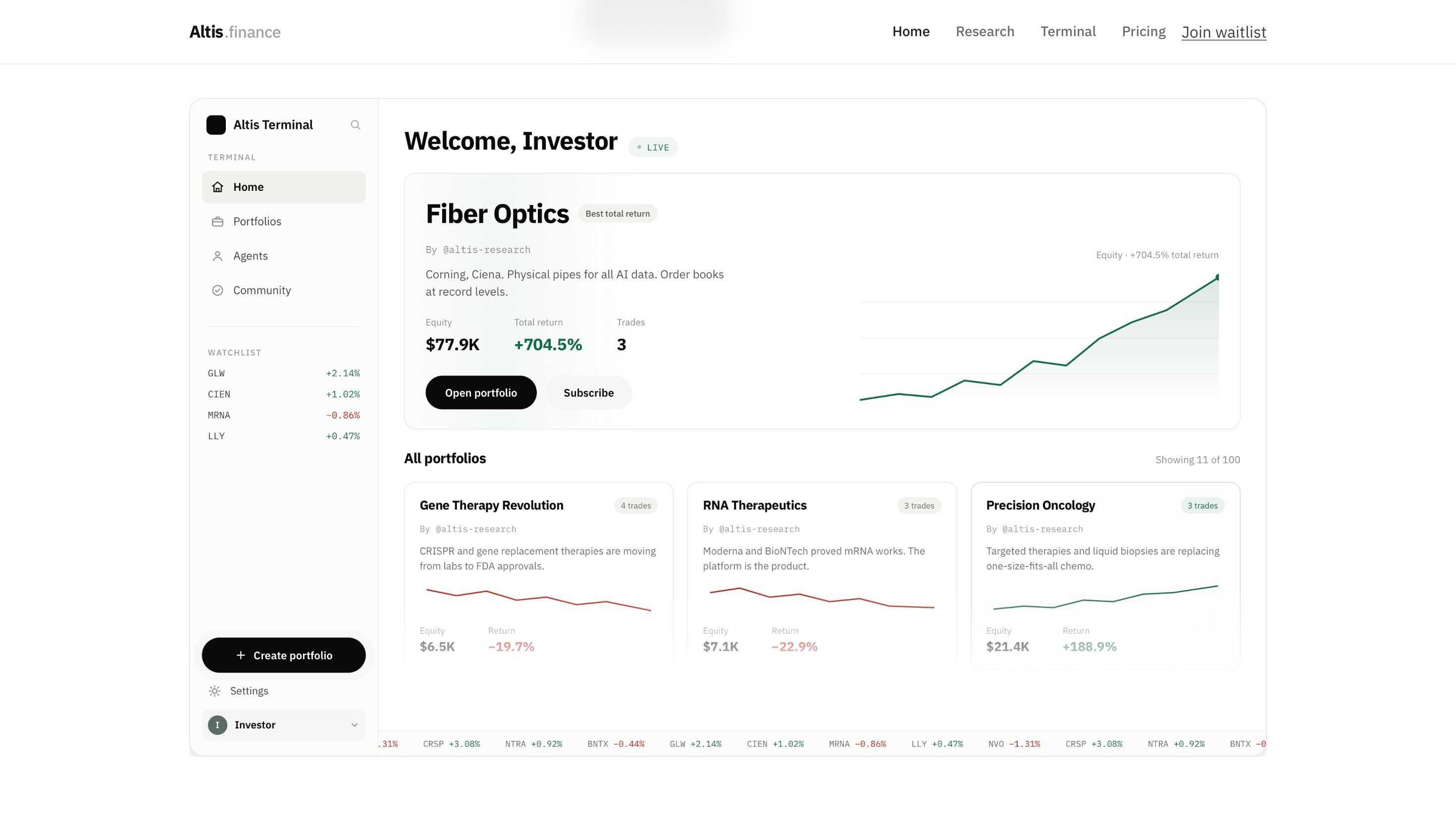
As a Macro Notes Premium subscriber, you’ll receive Altis Terminal at no additional cost.
You’ll be able to follow every portfolio I publish in real time, including Optical Fibre, Humanoid Robots, and more than 100 investment theses published across Macro Notes, Altis Research and other leading Substack investment newsletters.
Subscribe to Macro Notes Premium today to secure complimentary access to Altis Terminal and join the waiting list before the platform officially launches.
Subscribe today to be invited to the Telegram channel and receive exclusive insights before Altis Terminal opens to Premium members on 14 August.
Macro Notes Premium: The Humanoid Robot Investment Playbook
The free section explains why I believe humanoid robots could become one of the biggest technological shifts of the next decade.
But understanding a trend is only the first step.
The real question is:
How do you position yourself before mass adoption begins?
The biggest returns in technology are rarely generated after a revolution becomes obvious.
They are generated during the transition period—when the technology works, but before the majority of investors fully understand the opportunity.
This is exactly where I believe humanoid robotics stands today.
In this Premium edition, I will break down:
The 4 key events that could accelerate the transition from humanoid robot demonstrations to real-world industrial adoption.
Why the next 24 months could be the most important period for this industry.
My 2026-2027 investment strategy to gain exposure before mass adoption, without being overly dependent on Tesla.
How I am allocating capital across the three companies in this portfolio and why each position plays a different role in the thesis.
The key risks that could invalidate the thesis and the signals I am monitoring.
The goal is not to predict exactly which humanoid robot will win.
The goal is to identify the companies positioned to benefit from the entire ecosystem as physical AI moves from research labs into the real economy.